Open notation · Apache 2.0

The data layer for GRC engineering

JASCON writes standards, tailoring, risks, implementations, assessments and attestations as one graph of typed, content-addressed JSON objects. A Statement of Applicability becomes a computation, a machine check becomes something a second party can recompute, and a signature still verifies after the bundle is repackaged.

1.0.0 released 22 July 2026 2.0.0-rc.5 in review Independent project, one maintainer
excerpts
{
  "id": "https://cso.example/risk/R-2026-007",
  "title": {
    "en": "Tenant data exposure through long-lived KMS keys",
    "de": "Offenlegung von Mandantendaten durch langlebige KMS-Schlüssel"
  },
  "owner-ref": "https://cso.example/party/ciso",
  "state": "treated",
  "rating": { "level": "hoch",
              "scale-ref": "https://cso.example/scale/bsi-200-3-matrix" },
  "treatment": "modify",
  "treatments": [
    { "requirement-ref": "https://ns.bsi.bund.de/gspp/req/KONF.14.1",
      "statement-ids": ["s2"] }
  ],
  "tailoring-refs": ["https://ns.bsi.bund.de/gspp/tailoring/erhoeht"]
}
validate_core.pyrisk-coverage erhoeht: selected 3 · justified 1 · uncovered 2
{
  "id": "https://ns.bsi.bund.de/gspp/req/KONF.14.1",
  "version": "2026-07",
  "label": "KONF.14.1",
  "statements": [
    { "id": "s1",
      "modality": "may",
      "parameters": [
        { "name": "transport-crypto", "type": "choice", "cardinality": "one",
          "choices": [ { "value": "tls13" }, { "value": "tls12-pfs" } ] }
      ],
      "prose": { "de": "Konfiguration für Anwendungen KANN Kommunikation beim Transport über Netze nach {param:transport-crypto} verschlüsseln." } },
    { "id": "s2",
      "modality": "should",
      "prose": { "de": "Kryptographische Schlüssel SOLLTEN in regelmäßigen Abständen gewechselt werden." } }
  ],
  "facets": {
    "https://ns.bsi.bund.de/facet/gspp-taxonomy@1": { "by-statement": { "s1": { "sec-level": "normal-SdT" } } }
  }
}
validate_core.pyprose-params-resolve every {param:} token names a declared parameter
{
  "id": "https://ns.bsi.bund.de/gspp/tailoring/erhoeht",
  "version": "2026-07",
  "title": { "en": "Elevated protection level" },
  "selects": [
    { "set-ref": "https://ns.bsi.bund.de/gspp/set/baseline/example" }
  ],
  "operations": [
    { "op": "set-modality",
      "requirement-ref": "https://ns.bsi.bund.de/gspp/req/KONF.14.1",
      "statement-id": "s1",
      "modality": "must" },
    { "op": "set-parameter",
      "requirement-ref": "https://ns.bsi.bund.de/gspp/req/KONF.14.1",
      "statement-id": "s1",
      "parameter": "transport-crypto",
      "value": "tls13" }
  ]
}
validate_core.pymodality-monotonic may to must: monotone, no Deviation needed
{
  "id": "https://cso.example/check/LNX-SSH-1-maxauthtries",
  "requirement-ref": "https://cso.example/req/LNX-SSH-1",
  "statement-ids": ["s1"],
  "platform": "https://cso.example/platform/linux-host",
  "observes": [
    { "name": "sshd.maxauthtries", "type": "integer" }
  ],
  "criteria": [
    { "fact": "sshd.maxauthtries", "op": "at-most",
      "expected": { "param": "max-auth-tries" } }
  ],
  "validity": { "num": 24, "unit": "hours" },
  "confidence": "reviewed"
}
validate_core.pycheck-verdict observed 4, the Tailoring binds 4: satisfied
822/ 822

conformance vectors in 18 families pass in the reference validator. The vectors decide what conformant means.

measured at build
2

reference validators with identical counts: Python, and PowerShell 5.1 that runs on a stock Windows machine with nothing installed. Both run on every change.

measured 2026-11-12
11

published frameworks and lifecycle sets converted, among them ISM, Grundschutz++, SP 800-53, CSF 2.0 and C5. Every source path has a computed destination.

measured at 1.0.0
5,886

catalogue objects exported to OSCAL 1.2.2, validated against the NIST schema, re-imported and compared. All 5,886 are equal by semantic digest.

measured at 1.0.0

The first figure is recomputed whenever this site is built (commit 967e9f3). "Every source path" is path coverage: whether every value arrives is traced by a ledger on 6 corpora so far; there 122,891 of 214,455 source values are carried, 91,564 are no content by a checked rule, 0 are dropped and 0 are not accounted for. That and the other open points are listed under what is not proven.

01 Prior art

Ten things users and auditors need, format by format

Checked on 13 November 2026 against the schemas and the code of five neighbours: OSCAL 1.2.3, Gemara 1.6.0, CycloneDX 1.7.2, CISO Assistant and XCCDF 1.2 with SCAP 1.4. No neighbour's data was converted. A cell says what a format provides, not what a deployment does with it.

What helpsJASCONthis projectOSCALGemaraCycloneDXCISO AssistantSCAP / XCCDF
Controls selected by risk ISO/IEC 27001 6.1.2 and 6.1.3yesthe Statement of Applicability is computed; 2.0.0 candidatenoa risk exists only after assessmentpartialjoined only through threatsnotool onlynot in the exchange formatno
Risk acceptance on recordyesapprover, date, rationale; 2.0.0 candidatepartialno field for approver or datepartialno approver, no datenotool onlyapprover, date, expiryyesfor check results: authority, time, reason
Every decision traceablepartialweakening needs an approved exception; an author per change is optional and reportedpartialwho and when per document onlypartiala rationale, no authornopartialan audit log; no reason enforcedpartialan optional remark per change
Vendor recommendations kept apart from the controlsyesenforced on import; 2.0.0 candidateyescomponent definitions; adoption is a copypartialseparate files, no authority boundarypartialone file may also define the standardpartiala library update can rewrite assessmentspartialthe vendor's checks still decide
Exceptions and findings with deadlinesyestyped due dates; a review date on exceptions, reported once passedyesrisk deadlines, milestonesnopartialevidence expiry onlytool onlyexception expiry, due datesno
Automated checks as code, in any languageyesverdict recomputed from the observation; no runner; 2.0.0 candidatepartialruns recorded, no check logicpartialruns recorded, logic outside the formatpartiala command line as textpartialimports other tools' resultspartialany language only outside SCAP conformance
One chain from clause to implementation, check run and evidence fileyescheck runs: 2.0.0 candidateyeswith a hash on the evidencepartialno implementation recordpartialattachments carry no hashpartialtool results not linked to controlspartialtext references, no hashes
Several languages in one objectyesa language mapnononoyesa translations mapyesxml:lang
A signature that survives repackagingyesalso after a round trip through OSCALnobyte hashes onlynobundle bytes, signed by toolingpartiallost in the XML and protobuf formsnopartialre-indenting breaks it
Extensible by facets a contract that is enforced, pinned, and stops a tool that does not understand ityesschema pinned by digest; unknown semantics stop the toolpartialnamespaced props, no schema behind thempartialclosed schemas; a profile can narrow, not addpartialstring properties, optional registrytool onlythe format ignores unknown keyspartialforeign elements checked laxly

No: the schema was read and has nothing for it. Tool only: the CISO Assistant application has it, the library format that leaves the application does not. The ten rows were chosen by this project, and on two of them a neighbour was ahead until 13 November 2026: an exception in JASCON had no expiry, and no tailoring change recorded its own author. Both are in the candidate now, as optional fields a validator reports on. Several languages, recorded acceptance, deadlines and the evidence chain each exist somewhere else. No neighbour has risk joined to the selection of controls, a recomputed check verdict, or an extension with a pinned contract that stops a tool which does not understand it, as data that leaves the tool. The source of every cell: PRIOR-ART.md. What else each format misses: prior art. Why not extend one of them: handbook, appendix F.10.

02 The model

Documents become renderings of a graph

Eleven shallow object types, each with a global identifier, a version and two SHA-256 digests. What every measured framework needs sits in a fixed kernel. What one framework needs sits in a registered facet with a schema.

The JASCON object graph Content types on the left: Tailoring selects a RequirementSet, whose members are Requirements; a Mapping relates Requirements. System types on the right: Implementation, Assessment and Finding refer to a Component. In the middle a Risk justifies the Requirements that treat it, and a Check decides a Requirement for an Assessment. An Attestation binds the graph to the signed document. Content Organisation Systems selects members relates justifies satisfies against Tailoringselection and operations RequirementSetcatalogues, baselines Requirementclauses with modality Mappinga crosswalk edge Riskwhy it is in scope Checkhow a machine decides Componentsystems, services Implementationwho satisfies what Assessmentmethod and result Findinggap, actions, deviation Attestationbinds the semantic digests of the graph to the document a person signed
released in 1.0.0 new in the 2.0.0 candidate signature layer

Kernel

Binding force per clause, typed parameters and deadlines, membership, aliases, history.

Normative and closed. Changes ride a version.

Facets

Framework vocabulary: the German statement grammar, 800-53A objectives, protection goals.

Registered, schema-pinned. A tool that does not know one stops with a reason.

Annotations

Tracker ids, rendering hints, tool bookkeeping.

Outside every compliance computation and outside the semantic digest.

Failures are made unrepresentable where that is possible. A parameter token in prose must name a declared parameter. A tailoring operation addresses a statement by identity, so an upstream erratum cannot repoint it.

The eleven types, field by field

03 What changes

What follows when compliance data can be computed on

GRC engineering treats compliance like any other engineering artefact: versioned, typed, tested and signed. That needs data a program can reason about. Eight consequences, each with its mechanism and the state of its evidence. A ninth, the machine check, has the next section to itself.

ISO/IEC 27001 6.1.3 dmeasured on two bundles

The Statement of Applicability becomes a computation

A Risk names its owner, its treatment decision and the clauses that carry that decision. The primitive risk-coverage then lists every selected requirement that rests on no assessed risk. An auditor used to sample that from a spreadsheet.

Mechanism: the Risk type of the 2.0.0 candidate. On the example bundle the validator reports 3 selected, 1 justified, 2 uncovered, and names the two.

Mappingmeasured

A crosswalk is data with an author

A Mapping is an object of its own: source, target, relationship, confidence and provenance, down to the single statement. A third party's crosswalk belongs to neither catalogue and can be versioned, diffed and disputed.

Mechanism: relationship codes from NIST IR 8477. 1,008 Mappings in the 1.0.0 corpus.

Tailoringmeasured

Tailoring that survives an upstream release

A Tailoring selects by Set and changes by identity: this requirement, this statement, this parameter. Strengthening is free. Weakening needs a recorded Deviation, checked against a partial order of the modal verbs.

Mechanism: eight closed operations, deterministic resolution, no merge rules.

Attestationmeasured

A signature that survives repackaging

An attestation binds semantic digests. Re-indent a file or add a tracker id and the verdict is Semantic Match. Change a modal verb and the attestation no longer binds: a failure.

Mechanism: package digest over the bytes, semantic digest over the canonical content; DSSE envelope, Ed25519. Try it below.

Kernel rulesmeasured

Valid implies checkable

A {param:} token must name a declared, typed parameter. A facet pins its schema and declares which computations it changes. The converter built on these rules found 799 list values that a national catalogue in production packs into single comma-separated strings.

Mechanism: closed shapes, bound tokens, fail-closed facets.

textmeasured

One requirement, every language

Every human-readable field is a map from BCP 47 language tag to text. A requirement in German and English is one object with one identifier, which is what NIS2, DORA and the CRA will need across the Union's official languages.

Mechanism: the text primitive. The Grundschutz++ bundle carries de.

Implementationmeasured on one corpus

Inheritance with a named basis

A SaaS on a PaaS on an IaaS: every inherited edge names the upstream component and the specific authorization it leans on. Responsibility is typed per statement as provider, customer, shared or inherited.

Mechanism: one Implementation edge with inherited-from and basis-ref, checked link by link.

Exitmeasured

The way out is built in

Catalogue bundles export to OSCAL 1.2.2 that validates against NIST's schema and re-imports to the same digests. The reference validator is one Python file of 3,535 lines, and conformance is decided by public vectors.

Mechanism: export_oscal.py, the conformance corpus, Apache 2.0.

04 Checks

When the assessor is a machine

A scanner that exits with 0 or 1 hides its threshold and ignores the tailoring. A Check publishes the facts a collector reports and the comparisons that decide, and the run record carries the observation.

eleventh type, 2.0.0 candidate 205 vectors pass in three implementations
  • The Tailoring sets the pass mark. The criteria bind a parameter of the requirement. Tighten it and yesterday's observation is judged again, without a change to the code.
  • A verdict is recomputed. The validator evaluates the criteria on every recorded observation and rejects a row whose outcome differs.
  • A fleet gets a share, never a softer verdict. A check over many resources passes only if every one passes. All are evaluated, and the result reads "12 of 200 not satisfied (6 %)".
  • Measured fit: 481 of the 510 rules in the CIS Ubuntu 24.04 profiles of ComplianceAsCode fit the declarative form. The other 29 stay manual.
The design, the evidence chain and the open decisions
LNX-SSH-1 on bastion-01 worked example of the repository
The requirement

s1 The SSH daemon allows at most 4 authentication attempts per connection.

s2 The SSH daemon offers no cipher in CBC mode.

The collector observedsshd.ciphers
Recorded runs
Result of the assessment …

Computed in your browser by the app's port of check-verdict, the code that passes the 205 check vectors. No collector runs here; the observation is the one you set.

05 Try it

Change the bytes, then change the meaning

An example requirement from the repository, with the two digests its content manifest records. Edit it or use the buttons. Both digests are computed in your browser by the rule the validator uses.

jascon/examples/req-ism-1234.json editable

Change something

Package digestunchanged
sha256:… SHA-256 over the delivered bytes
Semantic digestunchanged
sha256:… SHA-256 over the canonical content, annotations left out
Verdict of the attestation check Full Match

Bytes and meaning are the ones recorded in the example bundle's content manifest.

06 The tool

A working app without a server

The JASCON app is a set of browser pages with no build step and no backend. A bundle you load stays in your browser. The tabs follow the order of the work.

  • Import an OSCAL catalogue or profile. The Grundschutz++ rules reproduce the shipped bundle object for object, by semantic digest.
  • Risk, Tailor, Map, Implement, Assess: every page writes real objects into the working set and exports a bundle with both digests per object.
  • Drafts from a model, verdicts from the kernel. Two pages can ask a language model once you enter a key. A draft is judged by the kernel rules and saved only when you take it.
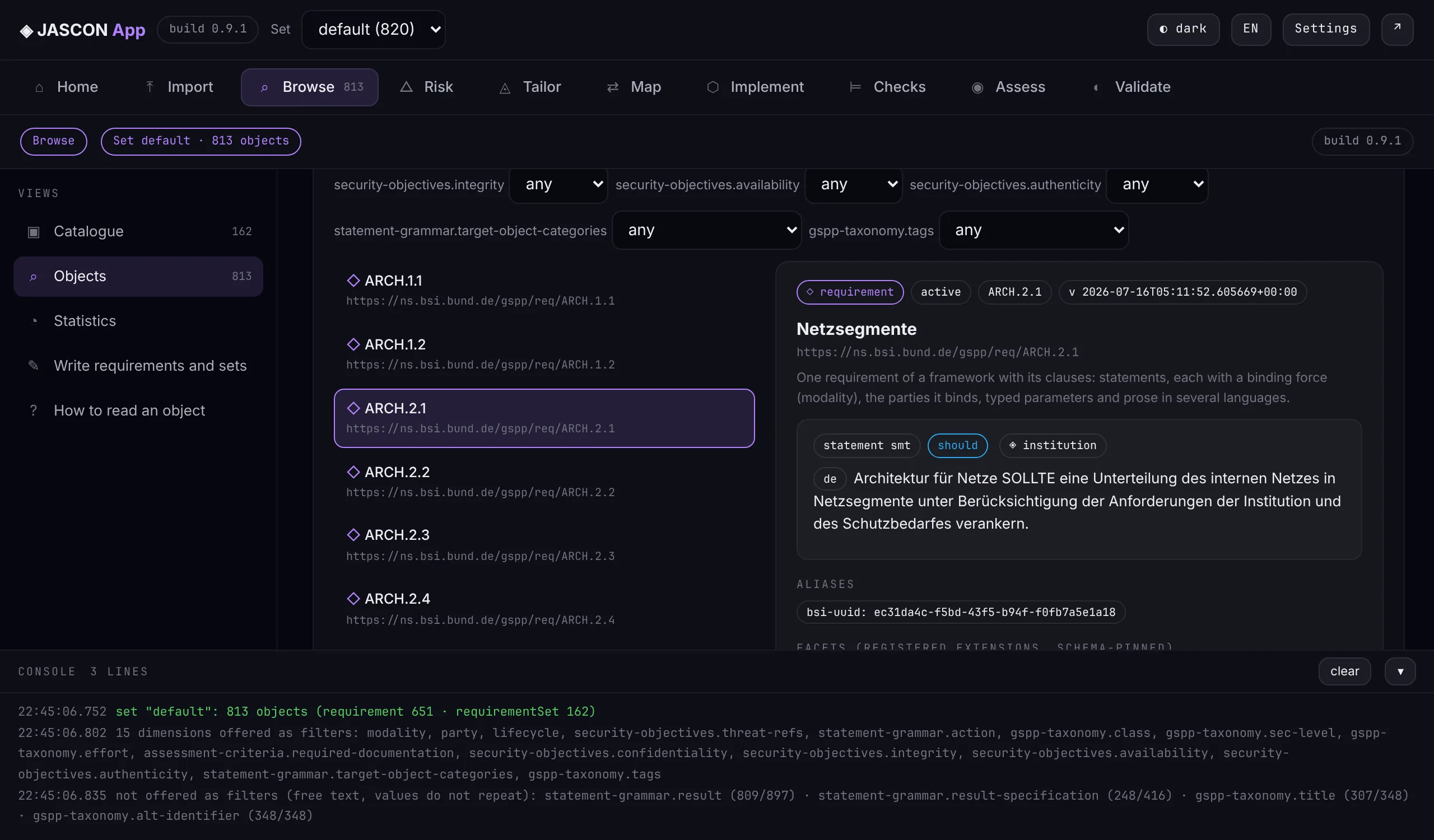
jascon.net/app/#load=../converted_examples/DE.BSI/bsi-core-bundle/&tool=browse
The Browse page on the Grundschutz++ bundle: a list of requirements, fifteen filters built from the data, and one requirement opened with its kernel fields, facets and annotations.

Browse on the Grundschutz++ bundle. The filters are built from the data: every kernel field and every facet value that repeats becomes one. Content: BSI, CC BY-SA 4.0.

Open this view
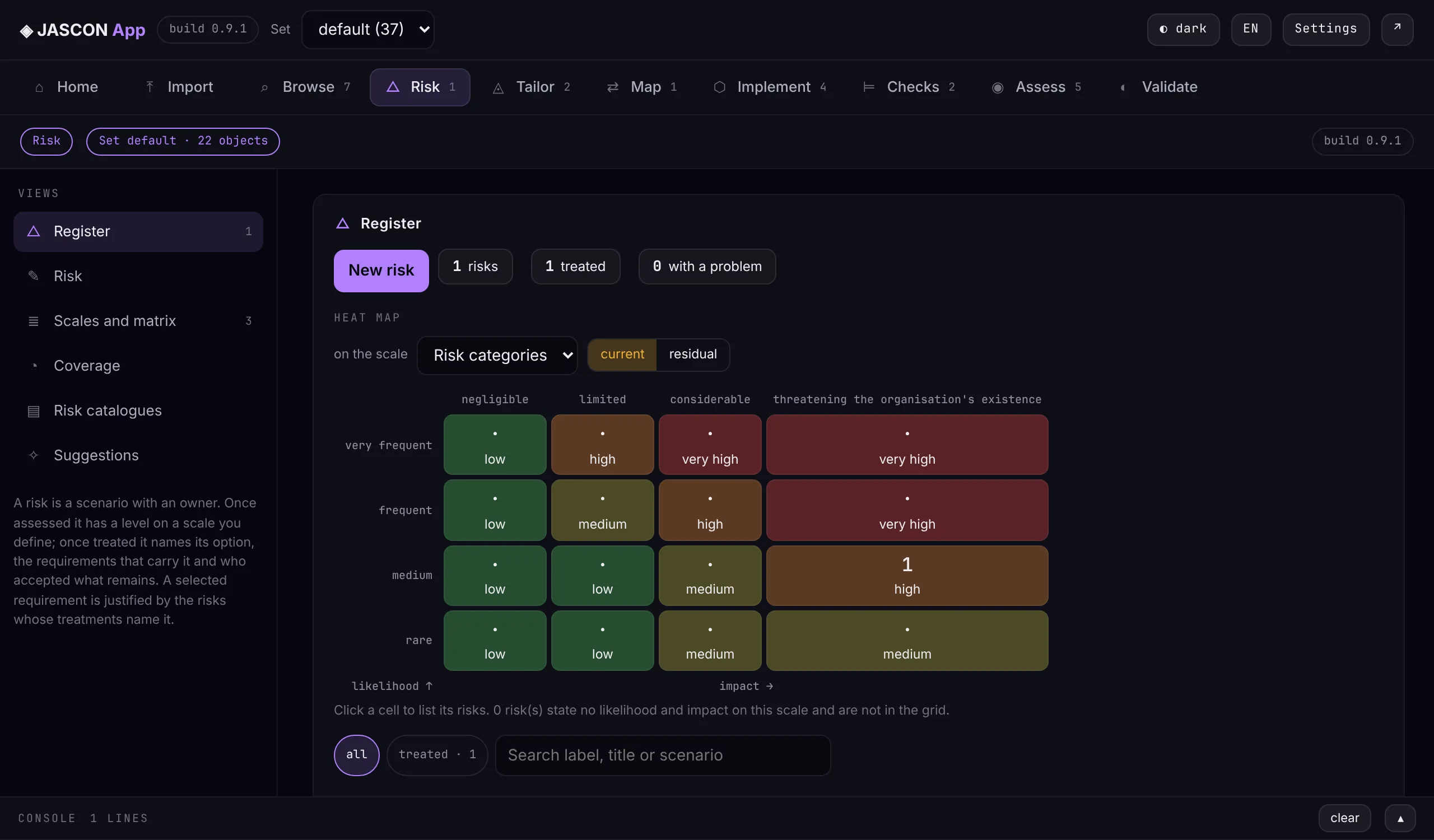
jascon.net/app/#load=../jascon/examples/&tool=risk
The Risk page: a register with a heat map of likelihood against impact on a scale the organisation defines.

The risk register on the example bundle, with the heat map of a BSI 200-3 matrix. Scales belong to the organisation; the kernel stores the level and the scale it is on.

Open this view
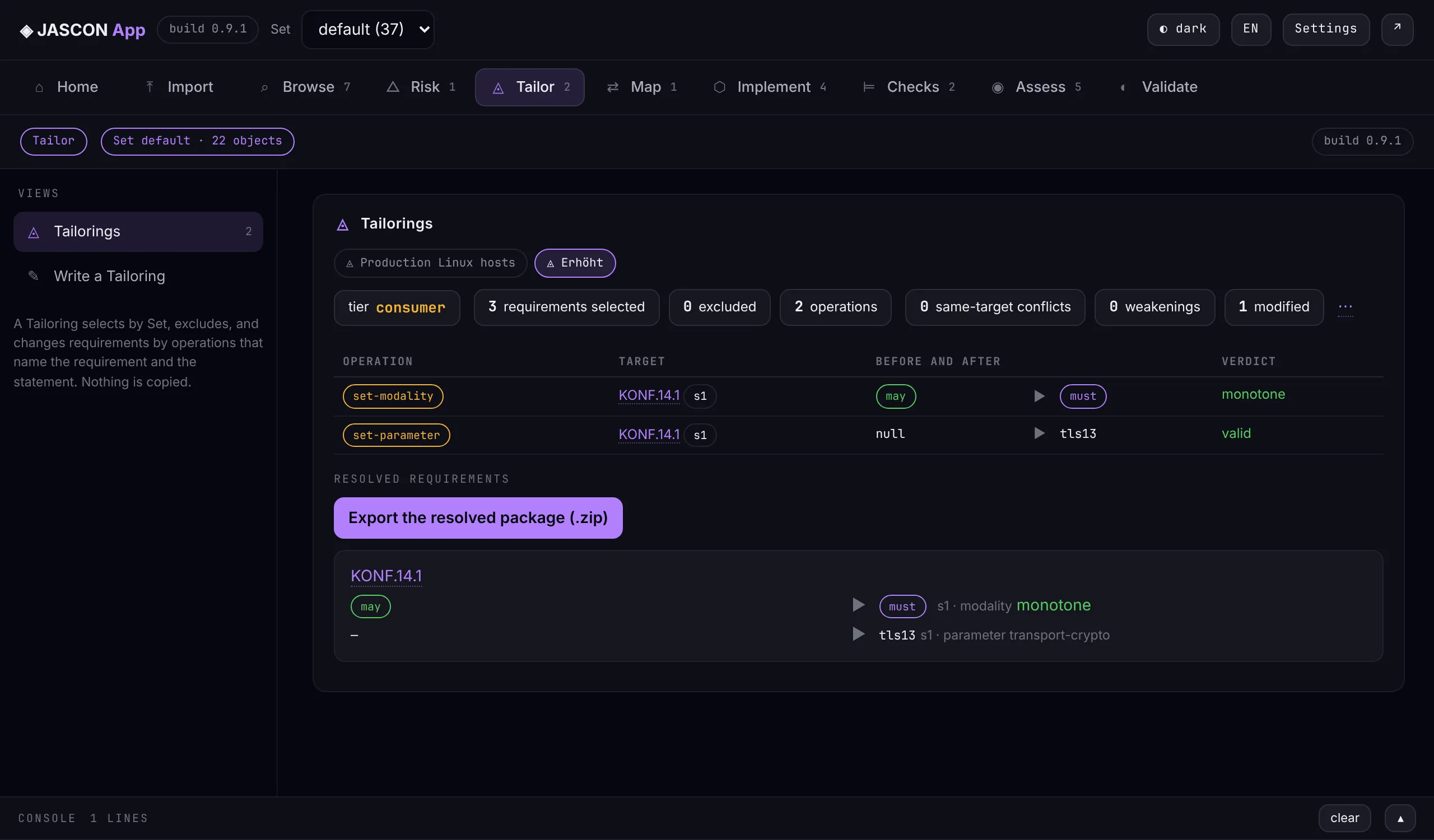
jascon.net/app/#load=../jascon/examples/&tool=tailor
The Tailor page: a Tailoring resolved, each operation with its target, the value before and after, and the verdict of the modality order.

A Tailoring resolved: each operation with its target, before and after, and the verdict. The authority tier is derived from the data.

Open this view
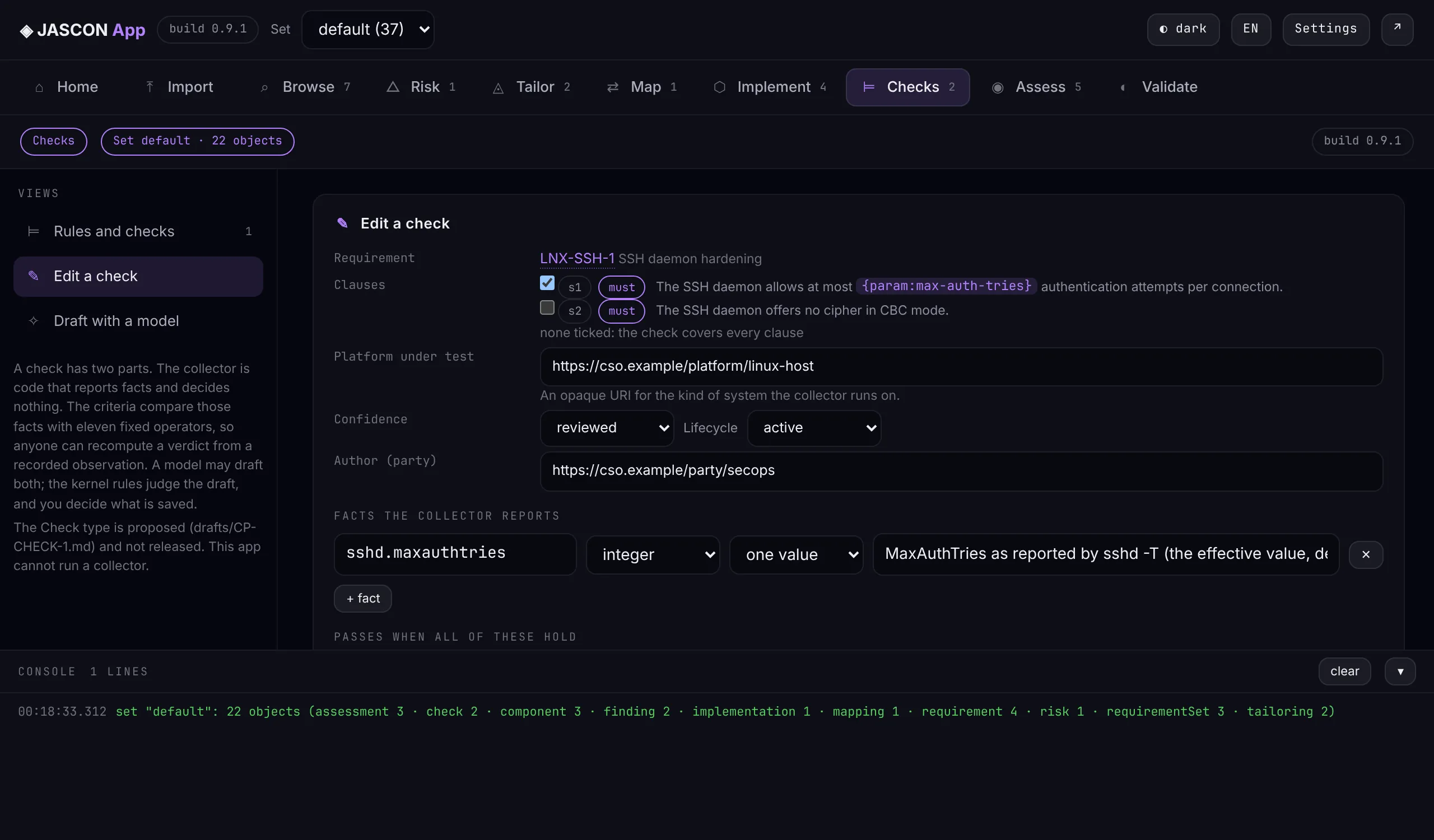
jascon.net/app/#load=../jascon/examples/&tool=checks
The Checks page: a check opened with the clauses of the requirement it covers, its platform and the facts its collector reports.

The Checks page on the example bundle: the facts a collector reports, the comparisons that decide, the collector code. A model can draft a check; the kernel rules and a read-only lint judge the draft. The app does not run collectors.

Open this view
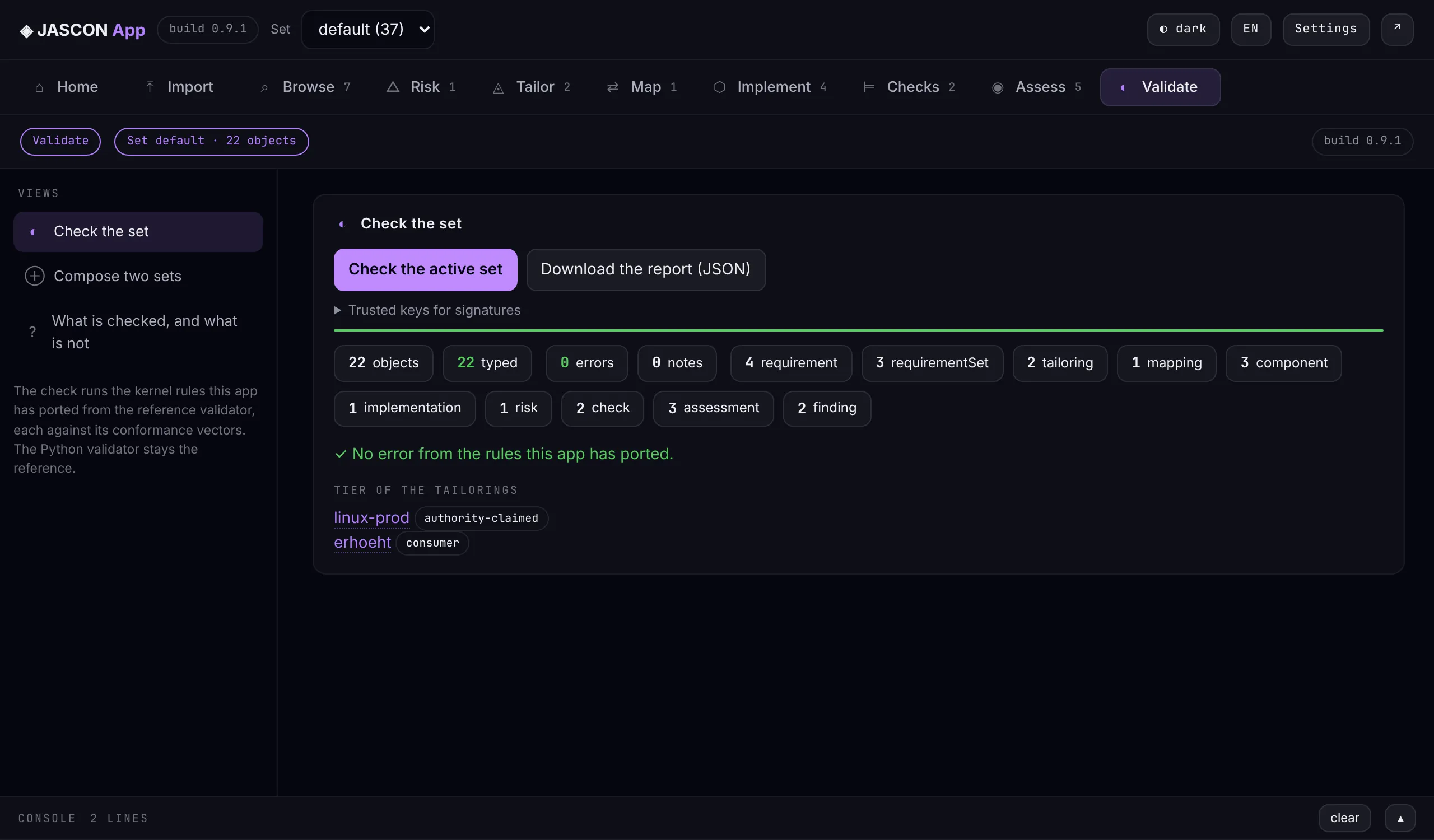
jascon.net/app/#load=../jascon/examples/&tool=validate
The Validate page after a run: object counts by type, no errors, and the derived tier of each Tailoring.

Validate runs the kernel rules ported from the reference validator, each against its conformance vectors. The Python validator stays the reference.

Open this view

07 Evidence

Every claim has to survive real catalogues

The project moves through evidence gates. A mechanism enters the specification when a published catalogue demands it, and a number on this site is either measured or labelled as something else.

measured designed for open
Gates, corpora and limits
mid-2026

Gate 1: the census

ISM, Grundschutz++ and FedRAMP CR26 inventoried to the last prop before the architecture was drawn. More than 70 % of 22,000 counted props needed no extension at all: they were membership, ordering, history and clause structure.

July 2026

Gate 2: executable

A normative JSON Schema, standard-library facets, a conformance corpus and a validator that re-verifies both digests of every object.

22 July 2026

Gates 3 and 4, release 1.0.0

SP 800-53 with its baselines, CSF 2.0 and a full SSP-to-POA&M set converted with no change to the kernel schema. Signature verification, a second validator in PowerShell, and the OSCAL round trip.

10 Nov 2026

2.0.0-rc.1: Risk

The tenth type. Every bundle of the 1.0.0 corpus validates unchanged under the new schema. An external review of the candidate produced 23 new vectors, each failing on the validator as it stood.

12 Nov 2026

2.0.0-rc.2: Check

The eleventh type, accepted with six decisions on the record. No census authority publishes a machine check, so the promotion rule gained a clause for data that only the consumer of a catalogue holds. 205 vectors, green in both validators. More on checks.

12 Nov 2026

2.0.0-rc.3: advice packs release candidate

Vendor recommendations as a bundle of Components that an import cannot use to change requirements or assessments. No new type, eleven rules, 74 vectors and a worked pack, green in both validators. More on advice packs.

13 Nov 2026

2.0.0-rc.4: who decided, and when release candidate

A tailoring and each of its entries, a risk, an implementation and a finding can say who decided and when; an exception can say when it was decided and when it is due for review. All of it is optional. A validator reports what is missing and which review dates have passed, with 40 vectors for the two reports. What that does not prove.

08 Who it is for

Four chairs, one first move each

Each of these costs a day and needs nobody's permission.

You publish a framework

Authorities and standards bodies

Your catalogue keeps its structure. Baselines become Sets, variants become Tailorings, your vocabulary becomes a facet with a schema.

First moveChoose a namespace, write one Set and re-encode ten requirements. Or open your catalogue in the Import page.

You build tools

GRC vendors and platform teams

One JSON Schema, one serialization, ten primitives with a rationale that prints on failure. No metaschema and no profile resolution.

First moveClone the conformance corpus and write a validator in your language. The vectors are the referee.

You run compliance

GRC engineers, CISOs, ISMS owners

Your risk register, Statement of Applicability, implementation statements and findings as files in a repository, reviewed like code.

First moveLoad SP 800-53 or Grundschutz++ in the app, write three risks and read the coverage.

You assess or buy

Auditors, assessors, procurement

You verify what was approved, on your own machine, offline. The PowerShell validator needs a stock Windows box and nothing else.

First moveAsk a supplier for a bundle and run the validator on it. Treat a conformance claim without corpus results as a datasheet.

One maintainer and no third-party user yet

That is the state on 2026-11-15, and the reason this site exists. Three contributions would change it most: a validator written by someone who did not write the specification, a catalogue converted by its own publisher, and objections that come with counts.